Showing posts with label Memoir. Show all posts

Thursday, December 9, 2010

Maus II: A Survivor's Tale: And Here My Troubles Began by Art Spiegelman (Pantheon, 1992)


GENRE: Graphic Novel - Memoir

HONORS: 1992 Eisner Award - Best Graphic Album: Reprint
1992 Harvey Award - Best Graphic Album of Previously Published Work
1993 Los Angeles Times Book Prize for Fiction
1993 Angoulême International Comics Festival Awards - Prize for Best Comic Book: Foreign comic
1993 Urhunden Prize

REVIEW: Art Spiegelman continues to interview his father's experiences as a survivor of the Holocaust, and it is in this second part that Art begins to feel some harsh guilt about his parent's past, as well as the present health and will of his father, Vladek. His father's narrative of the events leading to him and Anje's survival run in parallel to his current day behavior and senile attitude that burden Art and his girlfriend's stay with him. Spiegelman is able to elaborate on a very grim event by alternating scenes of the past and present. Art is often found as the one trying to get the facts straight, while his father is the one where readers see the emotion and trauma involved. The reader learns, not only about the torture and ruthless acts of genocide that the Jews had faced, but one also pick's up on Vladek's skill of using his congeniality to make connections and survive.

OPINION: MAUS is an absorbing take on such an unrelenting subject, but Spiegelman has made it deeply alluring to young readers through its presentation and pace.

IDEAS: A must read for a bibliography on the topic of the Holocaust or recommendation of non-fiction graphic novels.

Wednesday, December 8, 2010

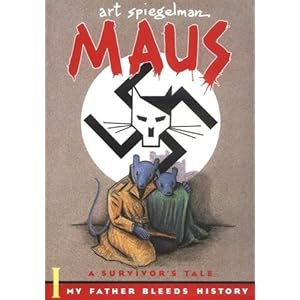
Maus I: A Survivor's Tale: My Father Bleeds History by Art Spiegelman (Pantheon, 1986)


GENRE: Graphic Novel, Historical - Holocaust

HONORS: 1992 Pulitzer Prize - Special Awards, and other international awards

REVIEW: In Maus I, Art Spiegelman, portrays his contemporary life as a cartoonist in New York who documents a story of his father's survival during the overtaking of Jews by Nazi Germany during World War II. Presented in comic book format, the story confronts serious issues concerning the annihilation of the Jewish race, the father's abrasive nature towards his second wife and those around him, as well as the events that lead to the suicide of his first wife and Art's mother, Anja. The characters portrayed in the comic provide a satirical tone to the story where felines are the Nazi's, pigs are the Polish, and mice are the Jews.

OPINION: An engrossing read that vividly captures the tracing of one’s family history. The story touches on how thousands of families were lead to concentration camps or to their deaths for their culture and identity. The comic format and rendered art is visually appealing and conveys a clear dialogue for young people to learn about the tragedy of the Holocaust without plowing through a history textbook.

IDEAS: A great addition to The Diary of Anne Frank, The Sunflower, and Night for high school curriculum about the Holocaust or for libraries to feature during the month of May, which is Jewish American Heritage Month.

Tuesday, November 30, 2010

I Can't Keep My Own Secrets: Six-Word Memoirs by Teens Famous & Obscure by Larry Smith and Rachel Fershleiser (Harper Teen, 2009)


GENRE: Memoir

HONORS: none

REVIEW: In this book, the memoir has taken a new form with teens expressing their inner most secrets and memories of their young lives. The memoirs range from the grim, "HIV: We could have saved her.", to the empowering, "Lost my virginity. It was fantastic.", and literary, "Holden caught me in the Rye." A book that is similar and along the lines of Postsecret and Other People's Love Letters, young people will appreciate flipping through the pages and quickly revering in the creatively sporadic expressions of emotion. In this book, teens will be able to relate to the flashed tales, and draw inspiration for themselves.

OPINION: One can't help but try to think about how they would summarize their life in six words, especially after reading this book. The beauty is that the memoirs are not categorized, the writers remain somewhat anonymous, and the pages are bold with each memoir having a different font face and size to show character. The memoirs include some famous young people, which are an added bonus to spot.

IDEAS: A great exercise for a creative writing workshop!

Tuesday, November 2, 2010

Lessons in Taxidermy: A Compendium of Safety and Danger by Bee Lavender (Punk Planet, 2005)


GENRE: Memoir

HONORS: None, so far

REVIEW: Lessons in Taxidermy is the book that author Bee Lavender did not have when her and her mother scoured bookstores for stories about children with cancer. In her memoir, Bee Lavender details her childhood illnesses and flashes back and forth between the minute to minute diagnosis she has in the emergency room as an adult. Most of the memoir is childhood to young adulthood timeline of surgeries, pain meds, 'freak show' identity, car crash, unplanned pregnancy, and social exclusion. As a child who grew up with every reason to die in the most unforgiving environment, Bee was destined to live even without the full will to put up a fight.

OPINION: Bee Lavender packs her memoir with squeamish, pain inducing details of her ailments and hospital visits, while harboring the tone of a monotonous attitude that is more realistic than the derived inspirational survivor's tale. Even though her perspective becomes too self-serving at times (which she admits) and the people in her life just seem to disappear without a trace of significance, her alternative edge and enthrallment with freak shows, vintage clothes, and counter culture is enough to interest women young and old who are in search for a story of true strength.

IDEAS: Bibliography about illness.

Persepolis 2: The Story of a Return by Marjane Satrapi (Pantheon, 2005)


GENRE: Graphic Novel - Memoir

HONORS: 2002 Angoulême Prize for Scenario

REVIEW: Volume 2 picks up where the first left off, which is when Marjane has separated from her parents to seek safety and study French in Austria. She is a young woman now, and the second volume reads more as a coming of age story than the first. Marjane has to find new friends and fit in, has become a bit promiscuous (compared to Iranian standards), and has sunk into deep depression. She even experiments with drugs and ends up homeless for a period of time. The second volume is what young adults will relate to the most because of Marjane's alienation and difficulty fitting into the world. After a series of dark events, she then returns to Iran to reunite with her family and to come to terms with her identity.

OPINION: The second volume does not focus so much on Iranian history, but it is where Marjane deals with her even darker past. Even though her parents felt that sending her away was protected her from the grim realities of warfare, she still could not escape her own pain of depression. On a side note, although graphic novels are a still a new and evolving, Persepolis will be deemed a classic. That is how GREAT it was.


IDEAS: see post for Volume 1.

Tuesday, October 26, 2010

Persepolis: The Story of a Childhood by Marjane Satrapi (Pantheon, 2004)


GENRE: Graphic Novel - Memoir

HONORS: 2001: Angoulême Coup de Coeur Award

REVIEW: Persepolis has given needed exposure to Iranian history that Americans do not often see or even too ignorant to learn about. The first volume is where Marjane Satrapi writes about her childhood growing up during the Islamic Revolution. This volume highlights the digression from a liberal culture to a strict, religious state. Reader's get to learn how the black robes and extreme Islamic domination are not a refection of Iran's citizens, but of their government. Before the war, Marjane lived a lavish life where her parents raised her to be educated and independent. In this graphic novel, she illustrates the transformation of the Iranian government, as well as the emotion of having to part with her lifestyle, her parents, and her identity because of the war.

OPINION: This book is as gripping and can be thought of as an equal predecessor of MAUS in terms of quality and content. Marjane has written something that is very relevant to our current political affairs, but in a light that can be understood from a Western standpoint. Her punk rock attitude and quirks of finding ways to express her individualism are a welcomed comic relief from such a heavy subject.

IDEAS: Notable curriculum for social studies or English class when focusing on war torn/ oil rich countries and how it has changed their culture.

Thursday, October 21, 2010

Breaking Through by Francisco Jimenez (Houghton Mifflin, 2001)


GENRE: Memoir - Latino

HONORS:Booklist Editors’ Choice
An American Library Association Best Book for Young Adults
American Library Association’s Pura Bupré Authors Honor Book Award (among many others!)

REVIEW:Breaking Through is the sequel to The Circuit , Jimenez's memoir about migrating as a child to the U.S. from Mexico. This story continues his experiences as a student who lived during a time of racial ignorance. Jimenez poetically writes about his experiences going to school in the day time, then working at night in the fields and later as a janitor to help support his family. He struggled to learn English and was often inclined to down play his heritage because of his yearning to have a 'normal' adolescence. However, his self-conscious father and deep loyalty to provide for his family did not faze his destiny to succeed.

OPINION: This memoir is a gripping tale and harsh reality of the struggles in the lives of migrants. Francisco Jimenez was able to rise above all the cultural barriers set before him, especially at a time of racial segregation and intolerance. This is a courageous tale that is rich in history, as well as Mexican culture.

IDEAS: Notable to incorporate in curriculum about immigration, California history, or documenting one's own family history.

Dear Diary by Leslie Arfin (VICE, 2008)


GENRE: Memoir - Drug Abuse

HONORS: none

REVIEW: "Dear Diary" is a lively, personal account of Lesley Arfin and her years as a teen growing up in New York City. Lesley has published excerpts of her journal since the age of thirteen and revisits each entry as an adult, which portray that "the lows are way lower and the highs are way higher". The uniqueness of this book is that she supplies the insight about each phase and emotion, and actually interviews her old friends and ex-boyfriends that she knew back when she was a teen. Her ultimate battle with heroine is the dark point of this story, which is realistically captured and non-condemning. The reader has a chance to conclude for herself the repercussions of use, and Lesley explicitly adds in an interview with her father about coming clean, "Another girl, somewhere in Minnesota, might be going through the same thing and feeling the same way. Maybe if she reads this, she'll realize that she is not the only one who goes through this stuff."

OPINION: This book reminded me of a contemporary Go Ask Alice. Teens will appreciate the truthfulness of her story, even though it seems that Lesley is putting down her old emotions as a teen, she is also spreading the message that it will all be better soon. It's a party girl story gone under.

IDEAS: Read-a-like for any kind of drug induced story.