Showing posts with label Fiction. Show all posts

Tuesday, December 14, 2010

Speak by Laurie Halse Anderson (Farrar Straus Giroux, 1999)


GENRE: Fiction

HONORS:2009 Margaret A. Edwards Award
American Library Association Best Books for Young Adults
American Library Association Quick Picks for Young Adults
Michael L. Printz Award - Honor
National Book Awards - Finalist
Booklist Editors' Choice
Horn Book Magazine Fanfare List
School Library Journal Best Books of the Year (amongst many others)

REVIEW: No one, not even the readers of this book (unless you read the jacket synopsis) know why Melinda Sordino has given up trying to socialize with her peers. She once had friends, but in the start of freshman year, they have all turned away from her. She has become a loner. Her parents seem uninvolved and her grades have dropped. Sometimes she even ditches class to escape. Anderson captures the social pressures of high school, but even more the trauma that occurs to many women when they have been raped. In this case Melinda did not feel like she had anyone to turn to, and it took a long time for her to gain the courage to tell anyone.

OPINION: This decorated book deserves all the awards that it has been given. It shows how tough a young adult's life can be, especially with the fear and isolation that one faces with being sexually violated. Anderson conveys that it is not always the parents or the authorities that can help; sometimes the smallest gestures of peers and outlets of expression can build one's self esteem.

IDEAS: Banned Book Week, as well as Rape and Domestic Violence Awareness Month in October.

Wednesday, November 24, 2010

The Earth, My Butt, and Other Big Round Things by Carolyn Mackler (Candlewick, 2005)


GENRE: Fiction

HONORS: Michael L. Printz Award for Honor Book
American Library Association Best Book for Young Adults
Pennsylvania School Librarians Association Young Adult Top Forty Title

REVIEW: Body image and self-confidence are the main themes in this story, which features Virgina AKA "Ginny" who is wide and round in every place. Unfortunately, she is raised in a family that bears no resemblance to here in appearance, ambition, and social status. Unfortunately, her parents are shallow and even though they want the 'best' for Ginny, they are not in her best interests. The book is thoughtfully written where her parents are not the superior voice in her self-image, even though they try hard to be. An English teacher, her out of town best friend, and talented make-out buddy named "Froggy" do see her potential, and are her outlets of fulfillment outside of her household. The side plot of her once idolized older brother's "date rape" also shows how ignorant her family is, even though they appear 'perfect'. Teens will like this book for obvious reasons of self- empowerment and a varying perspective from other books where the skinny girls reign supreme.

OPINION: This book was an engrossing read, and the author was successful in conveying the feeling of being overweight and self conscious. She did not have to result to portraying attitudes that were condescending to achieve this. Virgina was able to cope through writing and the book highlights that with some confidence, she would be able to overcome her feelings of guilt without downing a bag of Dorritos.

IDEAS: High school themes. Recommended for freshman ed! (maybe)

Seed Folks by Paul Fleischman (Harper, 1997)


GENRE: Fiction - Multicultural themes

HONORS:ALA Popular Paperbacks for Young Adults
ALA Best Book for Young Adults
School Library Journal Best Book
New York Public Library Books for the Teen Age (amongst many others)

REVIEW: Seedfolks is a slim novel that encompasses the personalities and diversity of a poor, urban neighborhood. The story focuses on an abandoned lot that expanded into a lively, vegetable bearing garden that started by one small act, which was the planting of lima beans by a young girl. Other neighbors didn't think her plant would grow, but when they watched from a far the care that she put into the plant, others began to join in. The story speaks about community and the tolerance that occurs when there is a common ground where differences can be understood. Fleischman uses short profiles of different demographics that dive into each individual's background and experiences with the garden. The story is symbolic and reflective of the differences in urban communities today.

OPINION: The profiles seemed to be difficult at times to grasp because of the overbearing of cultural characteristics, which may make a reader wonder of Fleischman has taken these profiles from real people or if they are over exaggerated prejudices. The themes are nonetheless promote multiculturalism and community, which is a value that young people can pick up quickly through this book and something that they will remember.

IDEAS: A book to promote multi-culturalism; library gardening program perhaps.

Thursday, October 21, 2010

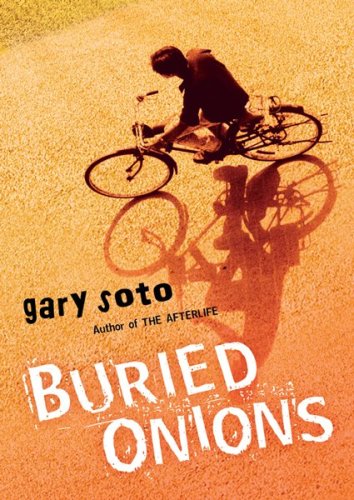
Buried Onions by Gary Soto (Gale, 2003)


GENRE: Fiction - Latino

HONORS: none

REVIEW: Buried Onions contains a lot of truth about the pressures, poverty, and racial oppression that Latinos and other ethnic groups face on a daily basis. Eddie is a 19-year old who resides in Fresno, California. He has lost a father and every male figure in his family, so he has to make ends meet by performing odd jobs like painting address numbers on curbs in the suburbs. His ultimate goal is to make his way outside of the Fresno ghetto and away from all the crime and violence. Unfortunately, violence still happens to find him when, Angel, a ruthless cholo is on his tail to get revenge. Eddie is still determined not to retreat to the violent streets, so with the help of his best friend and old coach, he is able to find a way out.

OPINION: The themes portrayed in this book highlight the very grim reality of individuals that live in repressed areas. Even though Eddie has the best intentions, he has to overcome the uncontrollable struggles and hardships put before him. Soto is successful at portraying a realistic perspective of young, first and second generation youth.

IDEAS: It is a great book to display and have for a booktalk in a library with a heavily diverse, urban population.

Tuesday, September 7, 2010

The Savage by David Almond (Candlewick, 2008)


GENRE: Fiction, Illustrated Novel

HONORS: None

REVIEW: At the loss of his father, Blue Blaker has some emotional issues to deal with. At the advise of a counselor, Blue decides to release some of his angst through writing and illustrating a story about a boy who scavenges in the woods and is without family, friends or knowledge of where he came from. Equipped with an ax and the capacity to hunt, the further Blue writes on, the closer "the Savage" comes to real life.

OPINION: Even though the book is written for ages 9 - 12, the illustrations and plot appear to be geared towards younger teens.* Blue uses profane language and has a ruthless attitude, which is exemplified through the character he creates in his story. When Blue and the Savage come in contact with each other, it allows the reader to think beyond literal terms and question Blue's psychological state. His mother also comes off as a little too supportive, which disqualifies some validity to the plot.

IDEAS: An attractive illustrative novel for discouraged readers that may be turned off by the usual YA novel, or a nice introduction to a creative writing workshop.

*The library that held this book has it labeled as "Teen" fiction.